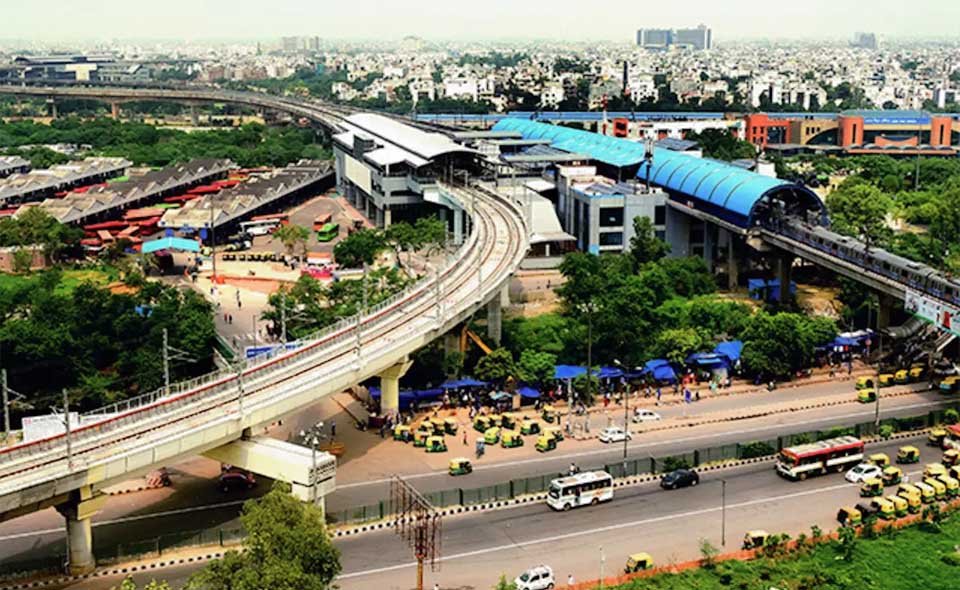
In a bustling metropolis like Chennai, where time is increasingly more valuable than gold, daily commutes that once consumed hours are being redefined by the rapid expansion of the Chennai Metro Rail and allied infrastructure projects, ushering in a new era of seamless connectivity that is transforming not only how people travel but also how the city’s real estate market behaves; this powerful “Metro Rail Effect” is driving a noticeable surge in property values across well-connected corridors, elevating demand in areas near metro stations, reducing travel fatigue, enhancing lifestyle convenience, and making once-overlooked localities highly desirable, thereby presenting a compelling opportunity for homebuyers seeking better quality of life and investors looking to capitalize on strong appreciation potential at a time when strategic infrastructure-led growth is reshaping Chennai’s urban and property landscape.
Phase 1: The Infrastructure Revolution – A City Reimagined
Chennai’s infrastructure story is one of rapid and strategic evolution. While the city has always been a key economic and cultural hub, its recent focus on large-scale connectivity projects is what truly sets it apart. The cornerstone of this revolution is the Chennai Metro Rail.
1. The Power of Phase 1 and the Promise of Phase 2
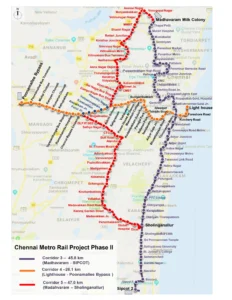
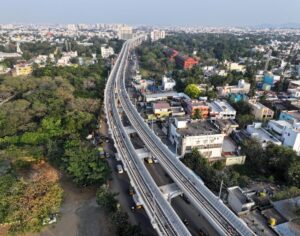
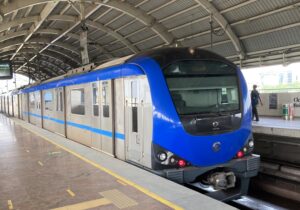
Phase 1 of the Chennai Metro, spanning 45 km, has already proven its mettle by linking key arterial roads and commercial hubs. It has made commuting a breeze for thousands, and in doing so, it has provided a clear blueprint for what’s to come. But it’s Phase 2, a massive expansion covering 118.9 km with 128 new stations, that is poised to change the city’s real estate landscape forever.
This ambitious project is divided into three key corridors:
- •Corridor 3: Madhavaram to SIPCOT (45.8 km): This line is a game-changer for the IT corridor, connecting northern Chennai with the IT hubs along the It will be a lifeline for thousands of tech professionals, making areas that were once considered far-flung suburbs into highly desirable residential zones.
- •Corridor 4: Light House to Poonamallee Bypass (26.1 km): This corridor will seamlessly connect the city’s central business districts to its western It will open up new residential opportunities and ease traffic congestion in areas like Vadapalani and Porur.
- •Corridor5: Madhavaram to Sholinganallur (47.0 km): Running parallel to the IT corridor, this line will connect Madhavaram in the north to the bustling IT hubs of Sholinganallur in the south, providing a much-needed alternative to the heavily congested roads.
The completion of these corridors, slated to happen in phases by 2028, will create an interconnected network that makes every corner of Chennai accessible.
2. More Than Just the Metro: A Holistic Approach
The Metro is not the only piece of the puzzle. Chennai’s government is investing in a host of other projects that collectively enhance the city’s liveability and economic viability.
- •ChennaiPeripheral Ring Road (CPRR): This ambitious 133 km road is designed to ease traffic congestion in the city center by diverting heavy vehicles. It is set to connect industrial hubs, providing a major boost to commercial and industrial real estate in areas along its route.
- •Elevated Expressways: Projects like the elevated corridor on OMR are aimed at decongesting major traffic choke points. This improved road connectivity complementsthe metro network, creating a multi-modal transport system that is fast, efficient, and reliable.
- •ProposedNew Greenfield Airport at Parandur: With the current airport reaching its capacity, plans for a second airport are well underway. This will not only boost Chennai’s position as an aviation hub but also drive significant real estate development in the surrounding areas.
Phase 2: The Direct Impact – Value on the Rise
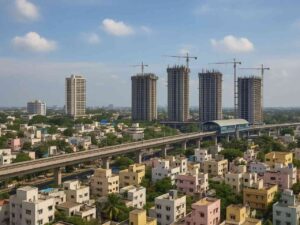
The link between infrastructure development and real estate appreciation is a proven fact, and for investors and homebuyers, the “Metro Rail Effect” translates into tangible benefits as properties within a 1–2 km radius of a metro station command a premium due to greater convenience, reduced commute times, enhanced accessibility to schools, hospitals, entertainment hubs, and retail centers, and consistently higher rental demand that boosts yields; market data from Phase 1 of the Chennai Metro shows that areas like Vadapalani and Koyambedu experienced a 25–35% rise in property values after operations began, and even during the pre-operation phase of Phase 2, experts predict up to 30% appreciation in areas near upcoming stations, with locations such as Madhavaram already recording an 8% increase in the past year driven by upcoming metro connectivity and improved road infrastructure.
Phase 3: The Hotspots – A Zone-by-Zone Investment Guide
Knowing that infrastructure boosts property values is one thing; knowing where to invest is another. Let’s break down the key areas along Chennai Metro’s Phase 2 corridors that are poised for significant growth.
1. The IT Corridor’s New Lifeline: Corridor 3 (Madhavaram to SIPCOT)
This corridor is a goldmine for investors looking to capitalize on Chennai’s booming IT sector. The line runs through areas with a high density of IT professionals, making it a prime location for residential and commercial investment.
- •Madhavaram: Already a real estate hotspot, this area is seeing a surge in demand dueto its new metro station and its intersection with major road It is a more affordable alternative to established localities like Anna Nagar but offers excellent connectivity and amenities.
- •Sholinganallur & SIPCOT: These areas are the heart of the IT corridor. The upcomingmetro will provide a seamless commute for the thousands of professionals working in companies like Infosys, Wipro, and This will drive up both residential and commercial property values, making it an ideal investment for both rental income and long-term appreciation.
Porur:Already a well-connected residential and commercial hub, Porur will see its appeal skyrocket with the new metro line. The improved connectivity will reduce commute times to other parts of the city and increase the demand for residential properties and office spaces.
2. Connecting the City’s Core: Corridor 4 (Light House to Poonamallee Bypass)
This corridor will bring a much-needed link between the city’s historical heart and its burgeoning western suburbs.
- •Porur & Poonamallee: These are two of the most significant beneficiaries of this line.Once considered the city’s fringe, they are now seeing a boom in residential and commercial developments. The new metro line will make these areas highly accessible, attracting families and professionals looking for spacious and affordable housing without sacrificing connectivity.
- •Vadapalani& Nagar: As the metro line cuts through these established commercial and entertainment hubs, it will enhance their value even further. Property here will be in high demand, appealing to those who want a blend of convenience and lifestyle.
3. The Northern-Southern Connect: Corridor 5 (Madhavaram to Sholinganallur)
This corridor acts as a vital link, bridging the gap between northern Chennai and the southern IT hubs.
- •Madipakkam& Perumbakkam: These affordable suburbs will be transformed by the new metro line. The improved connectivity will make them a viable housing option for a wider range of buyers and renters, leading to sustained price appreciation.
- •Villivakkam: A well-established residential area, Villivakkam will benefit from seamless connectivity to the city’s IT and commercial centers. This will drive new residential projects and increase the overall value of the locality.
Phase 4: The Investment Perspective – The Time is Now
For a smart investor, the ongoing infrastructure projects in Chennai present a once-in-a-generation opportunity. The time to invest is not when the projects are completed, but right now, during the construction phase, when the full potential has yet to be priced into the market.
1. Beyond Residential: The Rise of Commercial and Mixed-Use Developments
The metro’s impact isn’t limited to residential property. The new corridors are also spurring the growth of commercial real estate.
- IncreasedFootfall: Metro stations are natural hubs for commercial Retail spaces, food courts, and small businesses are thriving near these hubs.
- Mixed-Use Developments: With increased demand for both living and working spaces,developers are focusing on integrated mixed-use projects that offer a blend of residential units, office spaces, and retail outlets. These are proving to be highly valuable investments.
2. Government Initiatives and Future-Proofing Your Investment
The Tamil Nadu government is actively supporting this growth. They are incentivizing developers with policies like a higher Floor Space Index (FSI) for projects near metro corridors. This encourages high-quality, vertically-developed residential projects that are built to cater to the modern urban lifestyle. This means your investment is not just about a single property, but about becoming part of a planned, high-growth urban ecosystem.
Conclusion: Your Partner in Chennai’s Real Estate Future
Chennai’s real estate market is on a robust and sustainable growth trajectory, driven by strategic infrastructure projects, a booming IT and manufacturing sector, and strong government support, with the “Metro Rail Effect” now a reality reshaping the city block by block; whether you’re a seasoned investor seeking high-yield opportunities or a first-time homebuyer looking for a future-proof residence, the emerging localities along the new metro corridors offer exceptional potential, and at Homewala.com, we leverage our deep market expertise to provide up-to-date listings, data-driven insights, and expert guidance to help you find the perfect property in these rapidly growing hotspots—your future home or investment is just a click away.