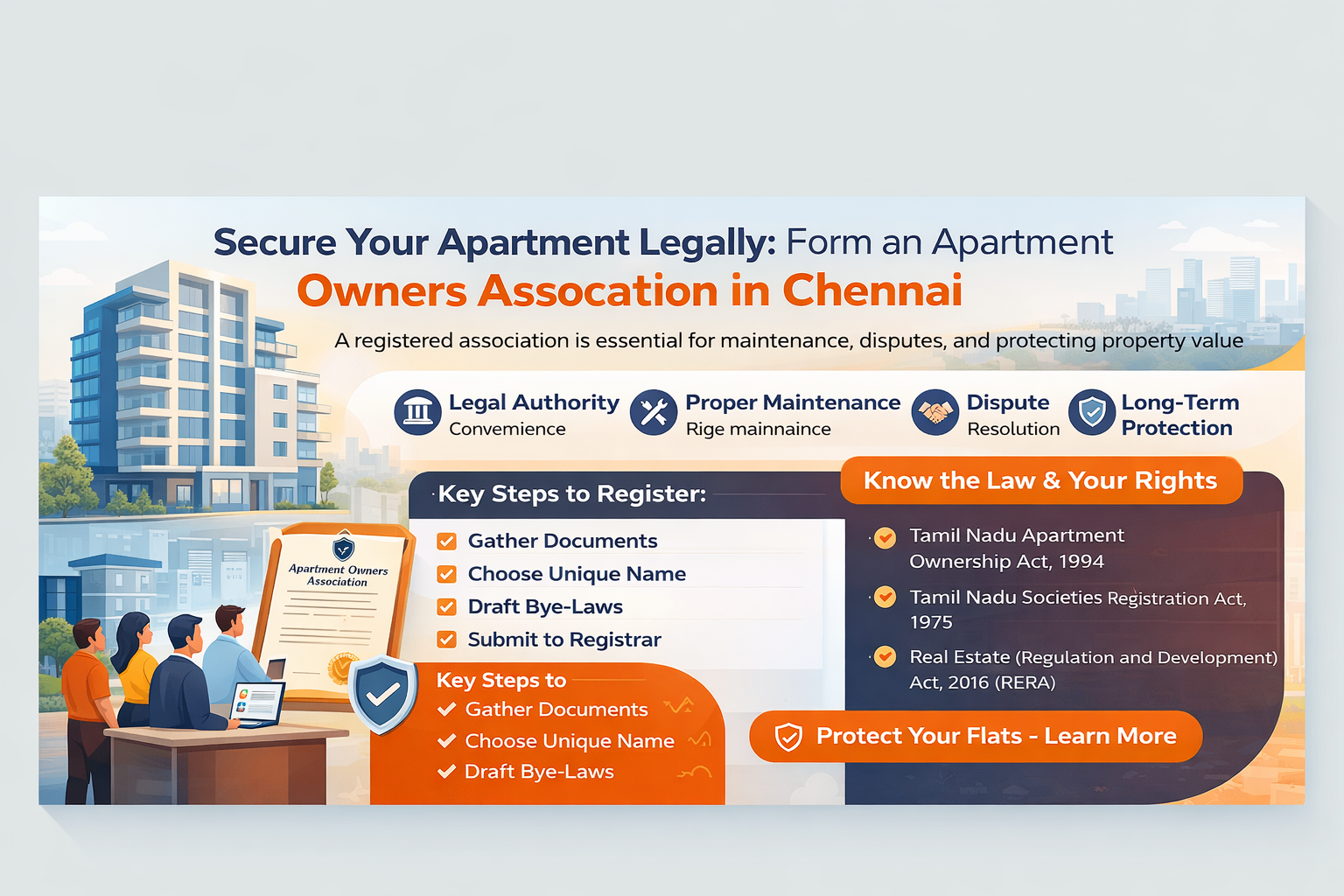
If you own a flat in Chennai, forming a registered Apartment Owners Association is not just administrative formality it is the legal backbone of lawful maintenance, dispute resolution, and long-term asset protection.
This guide explains:
● What an apartment association is
● Which laws govern it in Chennai
● Step-by-step registration process
● Builder obligations under RERA
● Legal powers of the association
Frequently asked questions
What Is an Apartment Owners Association in Chennai?
An Apartment Owners Association is a legally registered body formed by flat owners to manage common areas and collective interests within a residential building or gated community.
Common Areas Typically Include:
● Lifts
● Staircases and corridors
● Water supply systems
● Sewage and drainage lines
● Electrical infrastructure
● Parking areas
● Security cabins
● Terrace and open spaces
Since these are jointly owned, no single flat owner has independent authority over them. Only a registered association can legally manage, maintain, and represent them.

Is It Compulsory to Form an Apartment Association in Chennai?
While the law does not force immediate formation, under practical and regulatory conditions (especially RERA compliance), forming a registered association becomes legally necessary for:
● Enforcing maintenance collection
● Taking control from the builder
● Entering service contracts
● Filing legal cases
● Selling or mortgaging flats smoothly
In reality, apartment governance without registration has no legal enforceability.
Laws Governing Apartment Associations in Chennai
Tamil Nadu Apartment Ownership Act, 1994
This Act legally defines:
● Individual apartment ownership
● Undivided Share (UDS) rights
● Ownership of common areas
● Rights and obligations of apartment owners
Under this Act, builders cannot sell or retain common areas after selling flats.
Tamil Nadu Societies Registration Act, 1975
Most Chennai apartment associations are registered under this Act because it:
● Creates a separate legal identity
● Allows opening bank accounts
● Enables compulsory maintenance collection
● Grants power to sue or be sued
This is the most practical and widely used registration route.

Real Estate (Regulation and Development) Act, 2016 (RERA)
RERA mandates that:
● Builders must facilitate formation of association
● Common areas must be handed over
● Maintenance cannot be retained indefinitely by promoters
Failure can attract penalties and legal action.
How to Form an Apartment Owners Association in Chennai (Step-by-Step)
Step 1: Conduct a Preliminary Meeting
Flat owners discuss formation and elect a provisional committee.
Step 2: Choose a Unique Name
The name must not conflict with existing registered societies.
Step 3: Draft Key Documents
● Memorandum of Association (objectives)
● Bye-laws (internal governance rules)
Step 4: Collect Required Documents
● Registered sale deed copies
● ID and address proofs
● Meeting minutes
● Passport-size photographs
Step 5: Submit to Registrar of Societies
After verification, a Certificate of Registration is issued.
Once approved, the association becomes a legal entity.
● Minimum Requirements to Register
● Minimum 7 apartment owners
● Registered sale deeds
● Shared common areas
● Voluntary consent
● Basic documentation
Occupancy Certificate is advisable but not mandatory during initial registration.
What Powers Does a Registered Association Have?
After registration, the association can:
● Collect maintenance legally
● Impose penalties (as per bye-laws)
● Appoint security and vendors
● Maintain sinking fund
● Represent owners in court
●Initiate legal action against builder
It must also:
● Conduct Annual General Meetings (AGM)
● Maintain audited accounts
● File annual returns
● Follow its registered bye-laws strictly
Can Apartment Owners Form Association Without Builder?
Yes.
If the builder delays or refuses to cooperate, owners can independently register the association and seek remedies under RERA.
● Common Legal Issues in Chennai Apartments
● Builder refusing handover
● Maintenance default by owners
● Parking allocation disputes
● Encroachment of terrace or common areas
● Lack of transparency in accounts
Only a registered association has full legal standing to resolve these issues.
What Happens If No Association Is Formed?
Failure to form an association can lead to:
● No enforceable maintenance recovery
● Builder controlling funds indefinitely
● Difficulty during resale or loan processing
● Internal conflicts without legal resolution
● Administrative chaos
Over time, this significantly affects property value.
Proper association governance protects your investment long-term.